The Skyscraper Technique: Does It Still Work for Link Building? (2026)

Yes, the Skyscraper Technique still works for link building, but its effectiveness depends on how you execute it. Simply publishing a longer article than a competitor and emailing websites that link to their content is no longer enough.
Modern skyscraper link building requires original research, genuinely useful improvements, relevant backlink prospects, and personalized outreach. The goal is not to create the biggest resource. It is to create something publishers have a compelling reason to reference.
For businesses investing in SEO, the technique remains a useful part of a broader link building strategy when quality and relevance take priority over backlink volume.
The Skyscraper Technique is a content-driven link building strategy that involves finding popular content with existing backlinks, creating a substantially better resource, and contacting websites that linked to the original.
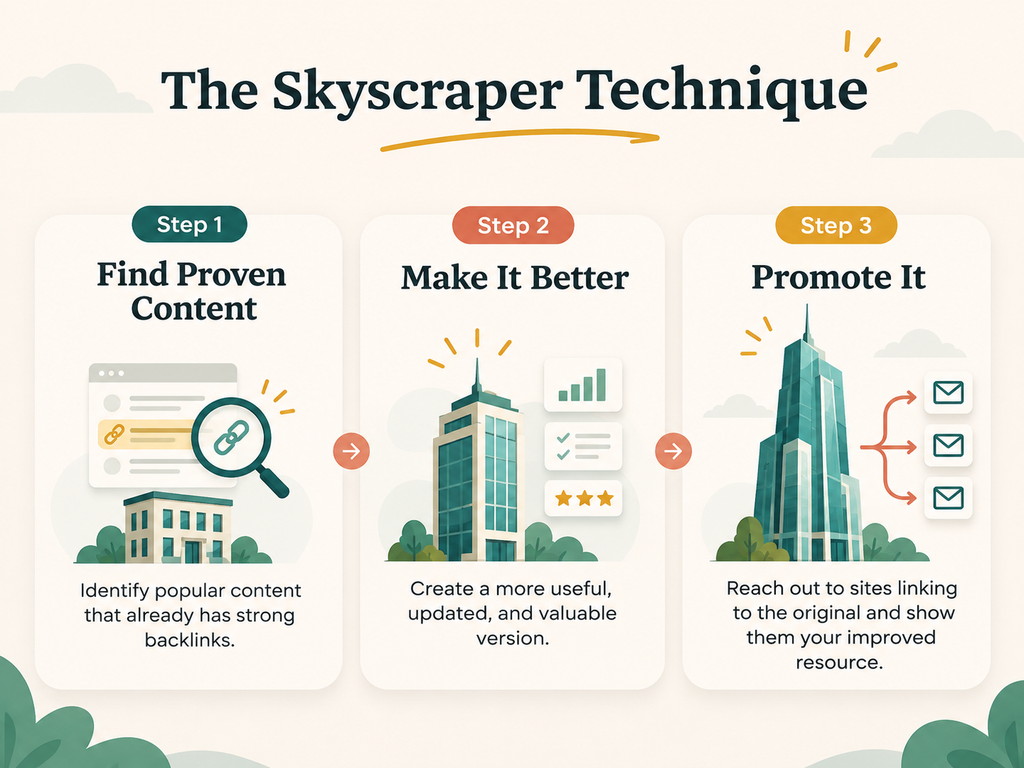
Popularized by Brian Dean of Backlinko, the approach follows three basic steps:
Example: Imagine a competitor has a guide explaining SEO trends with outdated statistics and limited examples. You could create a more comprehensive resource featuring current research, practical examples, expert commentary, and useful visualizations.
The important distinction is that better content doesn’t automatically earn high-quality backlinks. Publishers must recognize a reason to reference it.
Traditional skyscraper campaigns often fail because they confuse content quantity with linkability. A longer article does not necessarily offer publishers a stronger reason to replace an existing reference.
Several problems make the old approach less effective:
Brian Dean’s original Backlinko case study reported 17 acquired links from 160 outreach emails, approximately an 11% success rate. However, this was one campaign, not an industry-wide benchmark. Results should not be treated as a reliable prediction for campaigns in 2026.
Creating genuinely useful content and earning editorial references is a more sustainable approach.
The Skyscraper Technique works best when you treat it as a research-led content and relationship-building process, rather than a mass outreach campaign.
Follow these steps to improve your chances of earning relevant backlinks.
Start with competitor backlink analysis. Use an SEO tool to identify pages attracting referring domains within your niche.
Look beyond backlink counts. Examine:
Prioritize pages with genuine editorial links rather than simply choosing the competitor with the highest Domain Rating.
Once you find a promising page, understand what makes it link-worthy and where it falls short.
Look for opportunities such as:
For example, instead of rewriting a generic guide to SEO tools, create a comparison featuring current pricing, real use cases, limitations, and selection criteria.
Your content should provide a clear improvement that readers can recognize immediately.
A useful question to ask is: If the original competitor page disappeared tomorrow, would publishers have a good reason to reference your resource instead?
If the answer is unclear, improve the asset before starting outreach.
Export the websites linking to the original content and review each prospect manually.
Prioritize publishers whose articles would genuinely benefit from your resource. Remove irrelevant websites, low-quality directories, unrelated pages, and obvious link schemes.
Also check whether the linking article is still maintained. A page that has not been updated for years may offer a weaker opportunity than an actively maintained industry resource.
Avoid generic emails that simply announce a better article.
Instead, mention the specific page, explain what your resource contributes, and suggest how it could help the publisher’s readers.
For example:
Hi [Name],
I found your article about [topic] and noticed you referenced [existing resource].
We recently published a resource covering [specific improvement], including updated data and practical examples.
Thought it might be useful to your readers if you’re revisiting that section.
Here’s the resource: [URL]
Keep the message relevant and concise. Follow up politely if appropriate, but do not pressure publishers or repeatedly send automated requests.
Track more than the number of acquired backlinks. Monitor:
This helps determine whether the campaign delivers meaningful value rather than simply increasing backlink totals.
The Skyscraper Technique is one option among several link building techniques. Its suitability depends on your content assets, available resources, and acquisition goals.
| Strategy | Main approach | Best suited for |
| Skyscraper Technique | Improve popular linked content and pitch publishers | Content-rich websites |
| Broken link building | Replace broken resources with relevant alternatives | Existing useful resources |
| Digital PR | Earn coverage through research and newsworthy stories | Brands with original insights |
| Guest posting | Contribute valuable articles to relevant publications | Building industry visibility |
| Unlinked mentions | Request links for existing brand references | Established brands |
| Resource page outreach | Suggest useful resources to curated pages | Evergreen educational content |
The key difference is the opportunity being pursued. Skyscraper campaigns start with an existing page that already attracts links, while digital PR creates attention around a new story or asset.
You can also combine these approaches. For example, original research developed through a skyscraper campaign could become the foundation of a digital PR initiative.
Use the Skyscraper Technique when competing content has an established backlink profile, and you can create a noticeably more valuable alternative.
It is particularly suitable when:
However, it may not be the best investment when your website lacks useful content, your target topic attracts few editorial links, or your competitors already offer comprehensive resources.
In those situations, consider building industry relationships, publishing original research, pursuing relevant expert contributions, or exploring digital PR first.
The objective is to choose a strategy based on realistic opportunities, not follow a technique simply because it is popular.
The Skyscraper Technique still has a place in modern SEO, but success depends on creating something genuinely worth referencing. Publishing a longer article and sending hundreds of generic emails is not a sustainable link building strategy.
Focus on original value, relevant prospects, personalized communication, and measurable outcomes. Combine skyscraper campaigns with other acquisition methods when they offer better opportunities.
For businesses looking to simplify publisher discovery and backlink placement, Linkpedia offers a marketplace for exploring publishing opportunities across relevant niches. Whatever approach you choose, prioritize editorial relevance and long-term value over backlink volume.
Good link building strategies include digital PR, broken link building, competitor backlink analysis, original research, guest contributions, resource page outreach, and creating genuinely useful linkable assets.
The Skyscraper Technique is an SEO link building method that involves finding popular linked content, creating a better resource, and contacting relevant websites for backlinks.
Content earns links when it provides original research, reliable statistics, practical insights, useful tools, expert perspectives, or information that genuinely improves existing resources.
Yes, the Skyscraper Technique still works when content offers meaningful improvements and outreach targets relevant publishers. Generic content expansion and mass emailing rarely deliver consistent results.
The Skyscraper Technique is worth investing in when competitors have link-worthy content, your resource offers meaningful improvements, and targeted outreach justifies the production cost.