Why Your Website’s Authority Isn’t Growing Despite New Backlinks

You’ve spent weeks building backlinks, reaching out to websites, and securing new link placements. Your backlink count keeps increasing, but your Domain Authority (DA) or Domain Rating (DR) hasn’t changed.
It’s a common situation that leaves many website owners wondering whether their link-building efforts are actually working.
If you’re wondering why domain authority is not increasing, the problem often comes down to the strength, diversity, and characteristics of your backlinks.
Getting more backlinks doesn’t automatically improve website authority. Different SEO tools use different calculations, and some links may contribute very little to their scores.
Understanding these factors can help you identify problems and make more informed link-building decisions.
Your website’s authority may not increase because new backlinks come from existing referring domains, have limited link strength, or haven’t been included in your SEO tool’s calculations.
Another possibility is that you’re losing valuable backlinks while gaining new ones.
Example: Imagine your website earns 40 new backlinks, but 35 come from domains that already link to you. Your backlink count increases significantly, yet your Domain Rating might remain unchanged.
This happens because Ahrefs considers unique followed referring domains and their relative strength rather than simply counting every backlink.
Before acquiring more links, understand which authority metric you’re measuring and what influences its calculation.
Several factors can explain why backlinks are not improving your domain authority or Domain Rating. Identifying the actual reason is more useful than simply increasing your backlink count.
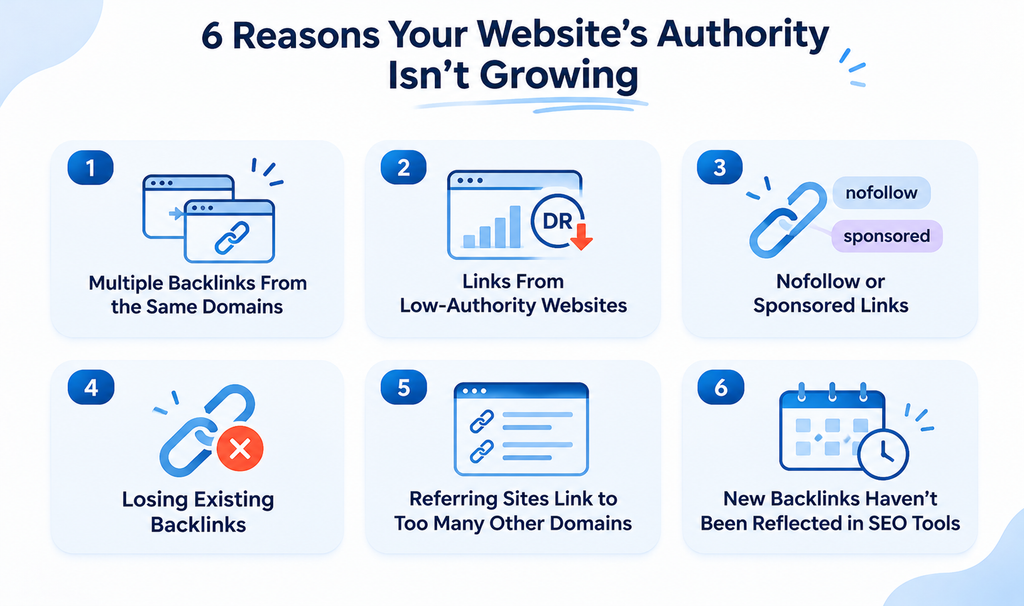
Getting several backlinks from the same website doesn’t necessarily improve your Domain Rating.
For example, earning ten backlinks from one domain is different from earning backlinks from ten unique websites.
Ahrefs primarily evaluates unique referring domains with followed links when calculating DR. Additional backlinks from the same domain don’t increase its contribution simply because there are more of them.
What you should do:
Compare your total backlinks with your unique referring domains. Focus on acquiring relevant links from websites that haven’t linked to you before.
Backlinks from websites with weak backlink profiles may have limited influence on your authority score.
However, low authority doesn’t automatically mean a website is low quality.
A newer, industry-specific publication might have a modest DR while offering relevant content and a genuine audience.
What you should do:
Evaluate referring websites based on topical relevance, editorial quality, backlink strength, and organic visibility.
Don’t reject a relevant website solely because its authority score is low, or assume that every high-DR placement is valuable.
Some backlinks contain attributes that affect how search engines and SEO tools interpret them.
Common examples include:
According to Ahrefs, links with these attributes don’t contribute to its Domain Rating calculation.
However, these backlinks may still provide referral traffic, brand exposure, and other benefits.
What you should do:
Review the attributes of newly acquired backlinks and understand how your chosen authority tool handles them.
Keep appropriate link attributes in place rather than changing them purely to increase a score.
Your backlink count may be increasing while valuable referring domains are disappearing.
For example, your website might gain 30 new backlinks but lose followed links from several strong referring domains.
As a result, Domain Rating may remain unchanged or even decrease.
Backlinks commonly disappear because pages are deleted, URLs change, or publishers update their content.
What you should do:
Compare new and lost referring domains over the same reporting period.
Investigate valuable missing links and recover them where appropriate through page restoration, relevant redirects, or publisher outreach.
A backlink from a high-DR website doesn’t automatically produce a noticeable authority increase.
Ahrefs considers how many unique websites a referring domain links to.
When a website links to numerous other domains, the strength it contributes to each one is distributed more widely.
For example, a website with DR 70 linking to thousands of domains may contribute less than expected.
What you should do:
Review outbound linking patterns, topical relevance, and overall website quality before selecting backlink opportunities.
A balanced evaluation is more useful than focusing exclusively on the publisher’s DR.
Sometimes, backlinks are live, but your SEO tool hasn’t discovered or processed them yet.
Ahrefs, Moz, and Semrush maintain separate backlink databases and crawling systems.
Their authority scores may therefore update at different times.
A recently published backlink might not appear immediately, especially when the referring page is crawled infrequently.
What you should do:
Check that the link is live, accessible, and points to the correct destination.
Monitor changes over several reporting periods rather than expecting every new backlink to produce an immediate score increase.
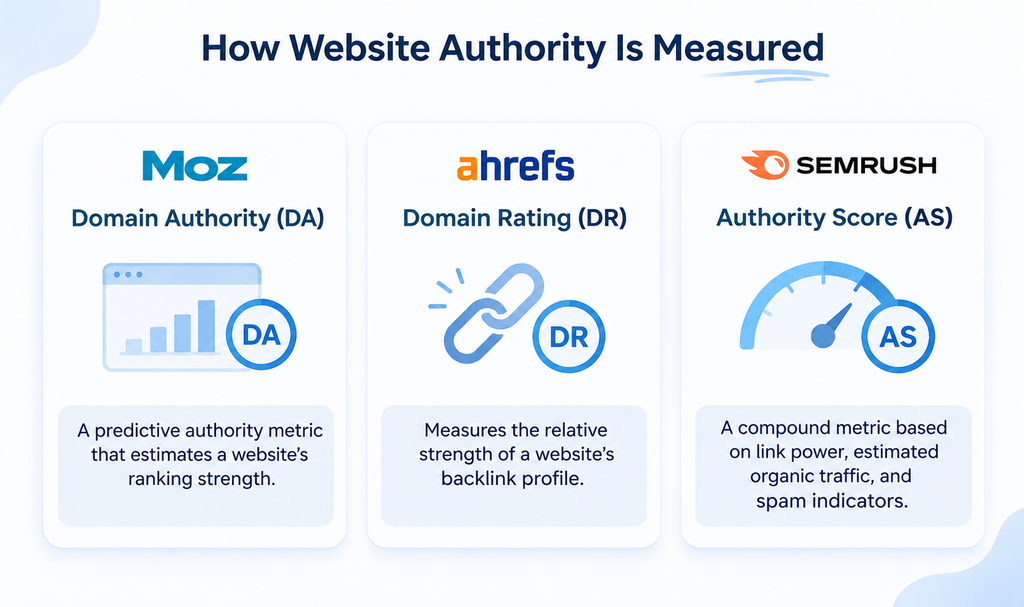
Website authority metrics are calculated using different methods depending on the SEO platform.
The three commonly used measurements are:
| Metric | Tool | What it measures |
|---|---|---|
| Domain Authority (DA) | Moz | Predictive ranking strength based on its link data and statistical model |
| Domain Rating (DR) | Ahrefs | Relative strength of a domain’s backlink profile |
| Authority Score (AS) | Semrush | Link strength, estimated organic traffic, and manipulation indicators |
These scores shouldn’t be compared directly because they use different calculations.
Also, DA, DR, and Authority Score are third-party metrics, not Google’s own ranking factors.
You can check your website’s authority using Moz, Ahrefs, or Semrush.
Follow these steps:
Always compare performance using the same tool and domain scope.
Comparing last month’s Moz DA with this month’s Ahrefs DR won’t provide a meaningful assessment of authority growth.
Improving website authority requires a thoughtful link-building strategy focused on relevant, credible websites.
Here are five practical approaches:
A strategic approach to building website authority helps businesses focus on meaningful link opportunities rather than backlink quantity alone.
You can even build backlinks for a new website with no domain authority. Domain Authority isn’t the only metric that determines whether your SEO strategy is performing well.
Other useful measurements include:
A backlink might send qualified visitors to your website without noticeably changing your DR.
Tracking these outcomes gives you a clearer understanding of the value created by your link-building efforts.
If your website’s authority isn’t growing despite new backlinks, the solution isn’t necessarily to build more links.
Review your referring domains, backlink quality, lost links, and the authority metric you’re tracking. Focus on building a relevant backlink profile that supports long-term organic visibility.
Platforms like Linkpedia can help businesses discover publisher opportunities as part of a broader link-building strategy. The priority should remain obtaining meaningful links rather than chasing authority scores alone.
Your domain authority may remain unchanged because new backlinks come from existing referring domains, offer limited link strength, or haven't been included in your SEO tool's calculations.
Domain Rating can change after Ahrefs discovers and processes relevant backlinks. However, there's no fixed timeline because changes depend on referring-domain strength, link discovery, and relative scoring.
Nofollow backlinks don't contribute to Ahrefs Domain Rating calculations. Moz uses a different scoring model, so their effects aren't identical. Such links can still generate referral traffic.
There's no fixed number of backlinks required to increase Domain Rating. Ahrefs considers unique followed referring domains, their strength, outbound linking patterns, and changes across its database.
Yes, Domain Rating can decrease despite gaining backlinks if valuable referring domains lose strength, followed links disappear, or other websites develop stronger backlink profiles over time.
Competitors may have higher authority with fewer backlinks because their referring domains are stronger or link to fewer websites. Total backlink volume alone doesn't determine authority scores.