What Happens When Hundreds of Backlinks Point to the Same URL?

A page receiving hundreds of backlinks may gain visibility, but the total count does not show whether those links are valuable. Their impact depends on the sources, relevance, context, and how naturally they were earned.
For example, 500 links from 10 websites create a different pattern from 500 links across 250 websites. Neither guarantees better rankings.
When many websites link to one URL, they create more paths for people to discover it. Relevant, editorially earned links can support visibility and bring referral visits.
However, every additional backlink does not add the same ranking value. Search engines evaluate links in context, and links created mainly to manipulate rankings may be treated as link spam. Some links may have little impact or be ignored.
Concentrated links can also happen naturally. A research report, free tool, industry resource, or newsjacking may become the main reference for a topic, attracting links because it is useful.
Backlink concentration is concerning when it reflects manipulative link building, not simply because many links point to one URL.
A sudden increase in backlinks is a reason to investigate, not proof of a penalty. A campaign, viral resource, or press mention can naturally attract many links quickly.
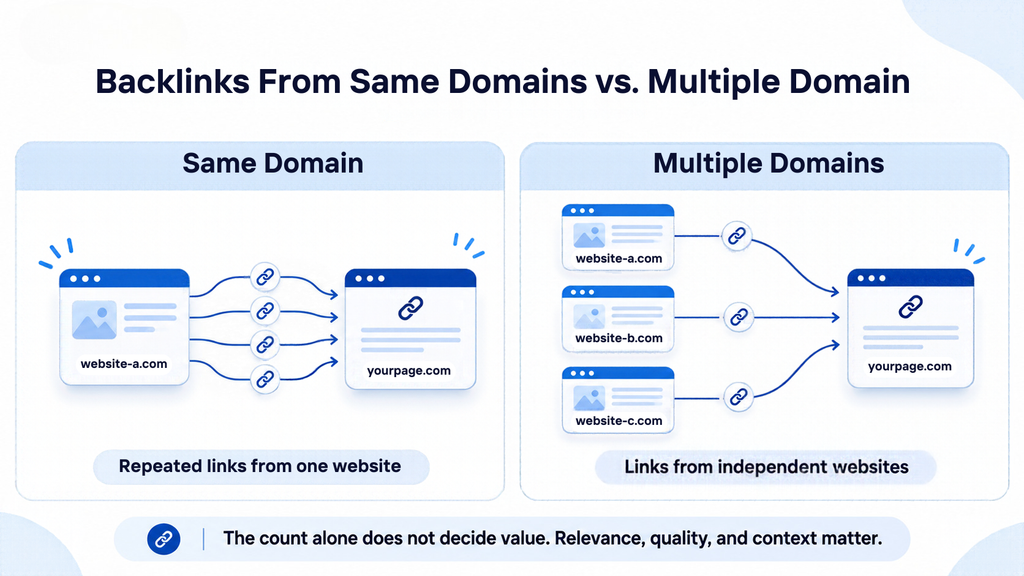
Backlinks from multiple domains provide wider source diversity; multiple links from one domain show repeated references from the same website. Neither pattern is automatically better.
| Factor | Multiple domains | Same domain |
| Source diversity | Links come from more independent websites | Links come from one website |
| Editorial context | May reflect different publishers and audiences | May reflect repeated references within one publication |
| Referral opportunities | Can introduce the page to different audiences | Can send relevant visitors from one audience |
| Interpretation | Shows broader domain-level coverage | Shows repeated linking from one source |
| SEO value | Depends on relevance, quality, and context | Also depends on relevance, quality, and context |
A relevant industry publication can link to your website more than once for legitimate reasons. Its article might cite your research, while a resource page links to the same report. Assess the page, domain, and reason for each link rather than treating every backlink as an independent endorsement.
Consider two pages with 500 backlinks each. This hypothetical comparison shows why totals need context.
Website A
Website B
Website A averages 50 backlinks per domain; Website B averages two. Website B has broader source diversity, but that does not automatically make it stronger. Its domains could be irrelevant or low quality, while Website A’s 10 sources could be respected industry publications.
The figures reveal nothing about rankings, anchor text, link attributes, or editorial quality. There is no universal ideal ratio of backlinks to referring domains.
To assess a page, combine backlink counts with source-level checks. Review the URL in a backlink tool, then compare findings with Google Search Console.
After the backlink audit, prioritize links that appear manipulative or violate Google’s policies. Address manipulative practices you control and request removal or appropriate link qualification where needed. Do not disavow links just because a third-party tool labels them toxic; use Google’s disavow tool cautiously.
Hundreds of backlinks to one URL can naturally result from publishing a resource people find useful. The count alone does not prove that a page is strong, over-optimized, or at risk. The sources, context, and acquisition methods matter more.
Compare referring domains, inspect linking pages, and investigate manipulative patterns. Build links because a page deserves to be referenced, not to reach an arbitrary target. Linkpedia offers credible, high-authority sites that help you earn relevant placements.
It can be beneficial when links come from relevant, trustworthy websites and are earned naturally. However, backlink quantity alone does not guarantee stronger rankings or meaningful referral traffic.
Not automatically. However, links created through manipulative schemes, irrelevant placements, or automated services may violate Google's spam policies and be ignored or trigger action under its published rules.
Referring domains show how many unique websites link to a page, while backlinks count individual links. Both need context when evaluating SEO value, because relevance and quality matter.
No, some pages naturally attract more external references than others. Prioritize useful, link-worthy pages and connect related resources with clear, relevant internal links for easier search discovery.
Google can discover links from different pages on one website. Its Search Console Links report combines duplicate links from the same source URL to the same target URL.