What Makes a Good Guest Posting Site for B2B Businesses?

A good guest posting site for B2B businesses has relevant industry coverage, a genuine professional audience, credible organic visibility, strong editorial standards, and natural outbound links. Evaluate these factors together instead of choosing publishers based on Domain Rating or price alone.
A valuable B2B guest posting site connects your brand with the right audience while offering a credible publishing environment. The best choice depends on your industry, campaign goals, and the relevance of the proposed article.
Five principles help establish whether a publisher deserves consideration:
In short: A good publisher offers a credible place to reach relevant readers, not simply an opportunity to acquire a backlink.
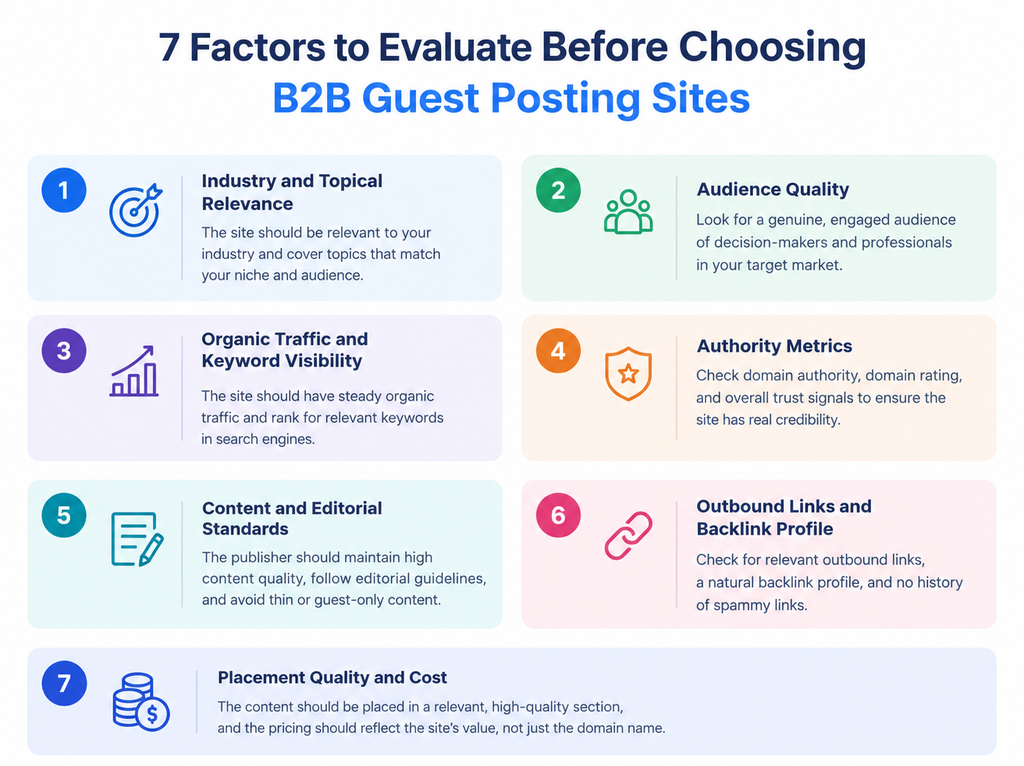
Evaluate B2B guest posting sites using seven factors: relevance, audience quality, organic visibility, authority metrics, editorial standards, backlink quality, and placement value. Together, these checks provide a more reliable assessment than any single SEO metric.
A relevant guest posting site publishes content connected to your industry or the business problems your audience wants to solve. It does not need to cover your exact niche, but the connection should make sense to readers.
Why it matters: Industry relevance helps your content reach an appropriate audience and makes contextual links more useful. A backlink from an unrelated website may look impressive in a metrics report but offer little meaningful exposure to your target market.
What to check:
Practical tip: For a SaaS company selling project management software, a business technology or operations publication is generally a more logical fit than a lifestyle blog with a higher DR.
A strong B2B publisher attracts readers who match your target market. The goal is not simply to reach more people, but to reach people who may benefit from your expertise, product, or service.
Why it matters: Relevant exposure can support brand awareness, referral visits, and industry credibility. However, a publisher’s audience should be assessed rather than assumed from its niche or traffic estimates.
What to check:
Practical tip: A specialist cybersecurity publication may be a better fit for an enterprise security company than a much larger general business website.
Organic traffic and keyword visibility help indicate whether a website attracts visitors through search engines. They can reveal whether a publisher has a functioning content presence beyond its ability to sell placements.
Why it matters: A site with relevant search visibility may provide additional discovery opportunities for your guest article. Nevertheless, estimated traffic is not proof of audience quality, and third-party traffic figures are not exact measurements.
What to check:
Practical tip: Use Ahrefs or Semrush to investigate traffic trends and ranking keywords. Treat estimates as directional evidence, and compare them with other quality signals before making a decision.
Domain Rating (DR) and Domain Authority (DA) are third-party metrics used to estimate aspects of a website’s backlink strength or ranking potential. Neither metric is a direct Google ranking score.
Why it matters: Authority metrics can help compare publishers, but they cannot establish whether a site reaches your buyers, publishes trustworthy content, or provides a suitable placement.
What to check:
Practical tip: Do not reject a specialist publisher simply because its DR is lower than a general website’s. Evaluate the complete profile instead of setting an arbitrary authority threshold.
Good guest posting sites publish useful, readable content that serves their audience. They maintain clear editorial expectations instead of accepting almost any article in exchange for payment.
Why it matters: Editorial quality influences how readers perceive the publication and the brands featured in its content. A well-integrated article can demonstrate expertise, while thin or repetitive content may undermine credibility.
What to check:
Practical tip: Read at least three recent articles before contacting a publisher. This gives you a more useful picture of its standards than judging the homepage alone.
A publisher’s outbound links reveal how it references other websites and whether commercial placements fit naturally into its content. Its own backlink profile can also provide clues about credibility and link quality.
Why it matters: Excessive unrelated links, manipulative anchor text, and pages created primarily to sell links can indicate a risky publishing environment.
What to check:
Practical tip: Open several published guest posts and assess whether their links genuinely support the surrounding discussion. Google classifies links bought primarily to manipulate search rankings as link spam, so paid placements require particular care.
A good placement offers a reasonable combination of relevance, editorial quality, audience fit, and price. The cheapest publisher is not necessarily the best value, and a high-priced placement is not automatically worthwhile.
Why it matters: Evaluating the specific offer helps prevent budget decisions based solely on headline metrics or promises of ranking improvements.
What to check:
Before committing to a placement, you can compare backlink marketplaces to assess publisher quality, pricing, and transparency.
Practical tip: Compare several suitable publishers using the same criteria. Avoid paying extra for guaranteed ranking improvements or links that are presented as a shortcut to higher Google positions.
Low-quality guest posting sites often show several warning signs together, such as unrelated content, weak search visibility, poor editorial standards, and unnatural linking patterns. Investigate the overall picture rather than relying on one suspicious metric.
A single warning sign does not automatically disqualify a publisher. For example, a new specialist website may have limited traffic while still producing excellent content. Consider the site’s age, niche, publishing history, and overall credibility before deciding.
Before committing to a publisher, confirm that it meets your campaign’s core requirements. Use this checklist to compare shortlisted websites consistently.
If a publisher fails several important checks, investigate further or choose a better-fit alternative. The final decision should reflect your objectives, not a single score.
A good guest posting site for B2B businesses combines industry relevance, an appropriate audience, credible organic visibility, strong editorial standards, and a natural link environment. Authority metrics and pricing help inform the decision, but neither should determine it alone.
Finding suitable publishers can take time, particularly when you need to compare multiple websites against the same criteria. Linkpedia helps businesses discover and compare publishing opportunities through its guest posting and backlink marketplace. Use your evaluation checklist to identify placements that fit your audience, content, and campaign goals.
A high-quality guest posting site publishes useful, relevant content, attracts an appropriate audience, maintains credible editorial standards, and has a natural backlink profile. No single metric establishes quality.
Evaluate a guest posting website by reviewing its niche relevance, audience, organic traffic, authority metrics, editorial quality, outbound links, and placement terms. Compare these signals before committing your budget.
No, Domain Rating is not inherently more important than niche relevance. DR estimates backlink strength, while relevance helps establish whether the publisher and its content suit your business and audience.
There is no universal minimum organic traffic requirement for guest posting sites. A smaller specialist publisher may offer better audience alignment than a larger website attracting mostly unrelated visitors.
Paid guest posting can offer legitimate sponsorship and audience exposure opportunities when placements serve readers. Links paid for primarily to manipulate search rankings can violate Google's spam policies.
Find relevant B2B guest posting sites through competitor backlink research, industry publications, targeted searches, direct outreach, and publisher marketplaces. Evaluate each candidate's relevance, editorial standards, and placement terms before proceeding.