High DR vs. High Relevance: Which Guest Posting Sites Should You Choose?

When choosing guest posting sites, consider topical relevance before relying on Domain Rating (DR) alone. A website with moderate DR, relevant content, and a genuine audience can be a better opportunity than a high-DR website covering unrelated topics.
However, the strongest publishers combine relevance, authority, organic visibility, and editorial quality. Evaluate these factors together instead of choosing websites based on a single metric.
High Domain Rating (DR) indicates that a website has a relatively strong backlink profile compared with other websites in Ahrefs’ database. DR is measured on a scale of 0 to 100 and is based on the strength of a domain’s backlink profile.
For marketers evaluating guest posting sites, DR provides a useful way to compare potential publishers. According to Ahrefs, a website with DR 70 generally has a stronger backlink profile than one with DR 25.
However, DR is a third-party SEO metric, not a Google ranking factor. It doesn’t directly measure a website’s content quality, topical relevance, organic traffic, or editorial credibility.
Example:
Website A: A general news website with DR 80 but publishes very little content about your industry.
Website B: A specialist publication with DR 40 but regularly covers your niche and attracts readers interested in your products or services.
Website B could be a more relevant publishing opportunity, even though its DR is lower.
Topical relevance matters because a backlink should make sense within the subject of the linking website, the article, and the destination page. It gives readers a logical reason to discover your content.
Consider a company offering project management software. A backlink from a business technology publication discussing team productivity has a clear contextual connection. A link from an unrelated entertainment website may have little relevance to the company’s audience.
There are three levels of relevance to consider:
All three matter when evaluating relevant backlinks.
Topical relevance also helps you reach audiences who may actually be interested in your business.
For example: A specialist marketing publication can introduce your brand to readers already exploring SEO, advertising, or content marketing.
That’s why a backlink strategy should consider the subject and audience of the publisher, not just the authority score from an SEO tool.
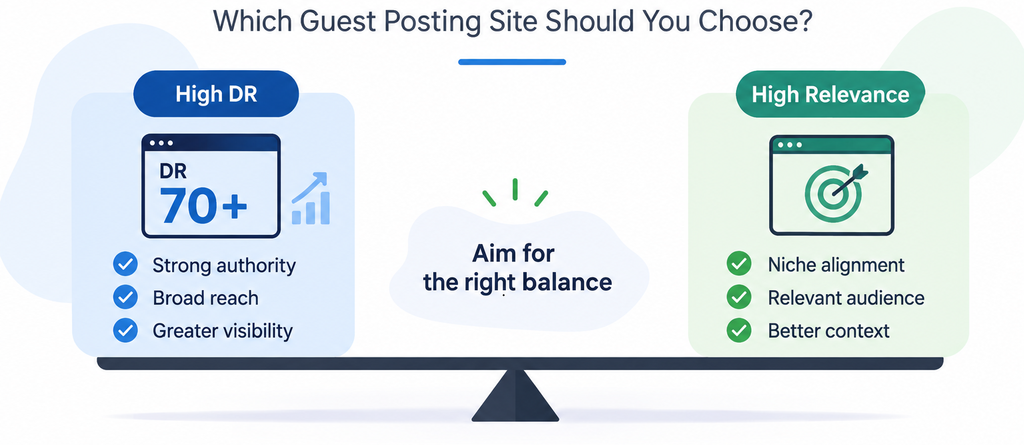
High DR and high relevance represent two different aspects of backlink evaluation. DR indicates the comparative strength of a website’s backlink profile, while relevance describes how closely its content and audience relate to your business.
Here is how the two compare:
| Evaluation factor | High-DR website | Highly relevant website |
| Main strength | Strong backlink profile | Strong topical connection |
| Content focus | May cover broad subjects | Covers your niche or related topics |
| Audience | Can be diverse | More closely aligned with your target audience |
| DR score | Usually higher | Can be moderate or high |
| Referral potential | Depends on the audience | Often more closely aligned with your offering |
| Main limitation | May lack topical connection | May have limited authority |
Choose a high-DR website when it has credible content, relevant publishing opportunities, and an audience that makes sense for your business.
High-authority publications are useful when your campaign aims to increase brand exposure, reach broader industry audiences, or earn coverage from premium publishers.
Consider a high-DR website when:
However, a high DR score should not compensate for poor content, irrelevant topics, or questionable publishing practices.
Also, examine the individual page where your backlink will appear. A strong domain does not automatically make every page on that website valuable.
Choose a highly relevant website when it regularly publishes content related to your industry and reaches an audience that could benefit from your expertise.
A niche publication may have a moderate DR but still offer a meaningful opportunity for referral traffic, industry exposure, and relevant brand mentions.
For example, a cybersecurity company could benefit from contributing to a specialist information security publication rather than choosing a high-DR lifestyle website simply because its metrics look impressive.
Prioritize niche-relevant websites when:
This does not mean every low-DR website is worth choosing. A relevant website with thin content, artificial traffic, or an unhealthy backlink profile can still be a poor opportunity.
The objective is to find publishers that combine topical relevance with reasonable website quality. A moderate DR should not automatically disqualify an otherwise credible niche publication.
Evaluate guest posting sites using multiple quality signals instead of making decisions based on DR alone. A consistent evaluation process helps you identify publishers that offer genuine editorial and audience value.
Use these checks before selecting a website:
1. Check topical relevance
Review the website’s recent articles, main categories, and editorial focus. Make sure it regularly covers your industry or subjects closely connected to your business.
2. Compare domain metrics
Check DR, referring domains, and the website’s backlink profile. Compare these metrics with similar publications instead of applying an arbitrary DR threshold.
3. Review organic traffic
Look at estimated organic traffic, ranking keywords, traffic trends, and the countries generating visits. Investigate unusual spikes or sharp declines before considering a placement.
4. Examine content quality
Read several recently published articles. Check whether they offer useful information, demonstrate subject knowledge, and follow consistent editorial standards. Avoid websites filled with repetitive, thin, or unrelated guest posts.
5. Inspect the backlink profile
Review the website’s referring domains and outgoing links. Look for suspicious link patterns, excessive commercial placements, and links from unrelated websites.
6. Check the actual placement
Ask where your article will appear, whether it will receive editorial review, and how naturally your link fits the content. Also clarify whether the placement is sponsored and how the link will be qualified.
A simple comparison table can help you shortlist publishers:
| Factor | Website A | Website B |
| DR | 75 | 42 |
| Topical relevance | Moderate | High |
| Organic traffic | Stable | Stable |
| Content quality | Good | Good |
| Audience fit | Moderate | High |
| Backlink profile | Healthy | Healthy |
In this example, Website B may be the better fit for a niche-specific campaign. Website A could still be useful if broader brand exposure is an important objective.
For larger campaigns, comparing backlink opportunities across publishers can also help organize your selection process. You can evaluate relevance, website metrics, placement details, and pricing before committing to a publisher.
Choosing good guest posting sites isn’t about finding the website with the highest DR. It is about identifying publishers offering a relevant audience, credible content, healthy backlink profiles, and appropriate placement opportunities.
High-DR websites can be valuable when their audience and content align with your campaign. Similarly, niche publications with moderate DR can offer meaningful opportunities when they provide genuine industry relevance.
Before selecting a publisher, compare relevance, authority, organic visibility, content quality, and placement context together. Platforms like Linkpedia help marketers discover and compare publishers across niches and website metrics, making selection more manageable.
No, a high-DR website is not always better. A relevant publisher with moderate DR, genuine traffic, and quality content can offer a stronger contextual opportunity.
Topical relevance should usually be a primary consideration, but DR also provides useful information. Evaluate both alongside organic traffic, content quality, and placement context.
Yes, a low-DR website can provide a valuable opportunity when it has relevant content, genuine readers, credible editorial standards, and a healthy backlink profile.
Evaluate its topical relevance, DR, organic traffic, referring domains, content quality, publishing activity, outbound links, and the editorial context of your proposed placement.
Choose niche-relevant websites when audience alignment and contextual fit are priorities. However, high-authority publishers can also be valuable when their content and readers match your campaign.