Dofollow vs. Nofollow Links: What Publishers Should Know

Dofollow links are standard links that search engines can consider when evaluating a page, while nofollow links use the rel=”nofollow” attribute to signal that the publisher does not want to endorse the destination in the same way.
Publishers should choose link attributes based on the relationship behind each link. Google recommends rel=”sponsored” for paid placements and rel=”ugc” for user-generated content.
A dofollow link is a regular HTML hyperlink without a qualifying rel attribute such as nofollow, sponsored, or ugc. The term “dofollow” is common in SEO, but there is no separate dofollow HTML attribute.
HTML example: <a href=”https://example.com/seo-guide”>SEO Guide</a>
SEO value:
Dofollow links can contribute to SEO because Google uses links as signals to discover pages and understand their relevance. However, not every followed link carries equal weight. The linking page’s relevance, surrounding content, and link context all matter.
These considerations also apply when choosing link-building techniques that prioritize relevant, useful links over backlink volume alone.
For publishers, the practical takeaway is simple: link naturally to useful sources when they help readers. You do not need to add a special attribute to every ordinary editorial link.
A nofollow link is a hyperlink containing rel=”nofollow”. Publishers use this attribute when they want to link to a page without implying the same endorsement as an ordinary editorial link.
HTML example:
<a href=”https://example.com/resource” rel=”nofollow”>External resource </a>
SEO value:
Google treats nofollow as a hint when interpreting links, rather than an absolute instruction. Therefore, it is inaccurate to claim that nofollow links can never influence search.
Publishers may use nofollow for links to sources they do not want to endorse or when another, more specific link attribute does not apply. For paid placements, Google prefers rel=”sponsored”, while nofollow remains an acceptable alternative.
Nofollow links can also bring referral visits, brand exposure, and relevant audiences. Assess their usefulness in context, not judge solely by their attribute.
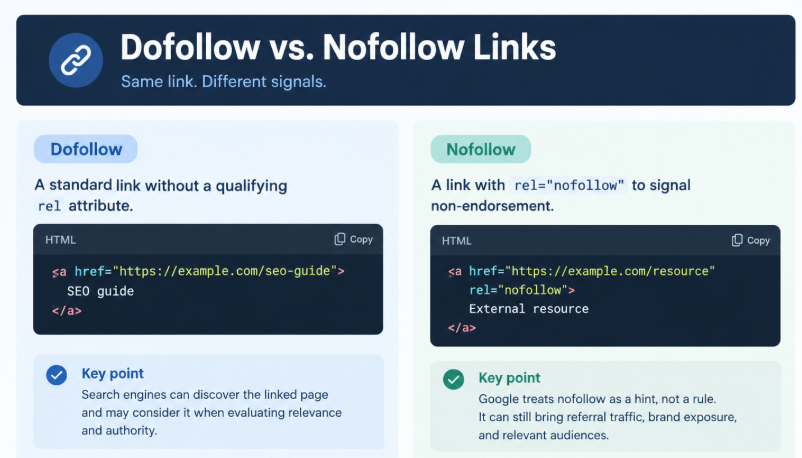
The main difference between dofollow and nofollow links is that a standard link carries no qualifying relationship attribute, whereas a nofollow link explicitly signals that the publisher does not want to endorse the destination in the same way.
| Factor | Dofollow link | Nofollow link |
| HTML attribute | No qualifying rel attribute | rel=”nofollow” |
| Main purpose | Ordinary editorial linking | Qualifying a link without implied endorsement |
| SEO interpretation | May be considered a ranking signal | Treated as a hint by Google |
| Common use case | Linking to useful, relevant sources | Linking to a destination the publisher does not want to endorse |
| Referral traffic | Possible | Possible |
| Guaranteed ranking benefit | No | No guaranteed outcome |
Neither type guarantees higher rankings. A relevant link from a credible publication may be more useful overall than a link from an unrelated website, regardless of its dofollow or nofollow status.
Publishers should also distinguish nofollow from sponsored and UGC attributes. Those attributes communicate more specific information about why a link exists.
Publishers should choose link attributes according to the link’s purpose and the relationship behind it. Google’s guidance distinguishes ordinary editorial links, paid placements, and links submitted through user-generated content.
1. Use dofollow links when:
For example, a publisher writing about keyword research might link to an official search documentation page because it supports a factual explanation. An ordinary link is appropriate when no paid or user-generated relationship needs qualification.
2. Use nofollow links when:
Do not automatically mark every external link as nofollow. Editorial links to useful, trustworthy resources do not require this attribute by default.
3. Use sponsored links when:
HTML Example: <a href=”https://example.com/product” rel=”sponsored”>View the product</a>
Google recommends the sponsored attribute for paid placements. Buying or selling links intended to manipulate rankings can violate its spam policies, so publishers should not promise unqualified ranking credit as part of a paid placement.
When evaluating paid publishing opportunities, publishers and marketers should also understand what to check before choosing a backlink marketplace, including placement details, website quality, and link attributes.
4. Use UGC links when:
HTML Example: <a href=”https://example.com” rel=”ugc”>Community resource</a>
Publishers can combine attributes when necessary, such as rel=”ugc nofollow”. The important point is to describe the link relationship accurately rather than selecting an attribute simply because it appears more valuable for SEO.
Yes, nofollow links can still be valuable in 2026 because they can introduce your brand to relevant audiences and generate referral traffic. However, their direct impact on rankings is not guaranteed.
Here are four reasons publishers and marketers should look beyond the link attribute:
When evaluating a backlink opportunity, consider its relevance, editorial quality, potential audience, and compliance with search guidelines. Do not assume that nofollow links are worthless or that a large number of them will automatically improve SEO.
You can check whether a link is dofollow or nofollow by inspecting its HTML and examining the rel attribute. This works in most modern desktop browsers and doesn’t require a paid SEO tool.
For example, an SEO tool may report a backlink as dofollow, but inspecting the actual link helps you verify its current HTML attributes. Remember that link attributes can change, so check the live page when evaluating an important placement.
The difference between dofollow and nofollow links comes down to how the link is qualified and the relationship it represents. Standard editorial links can serve as ranking signals, while nofollow links communicate non-endorsement. Sponsored and UGC attributes help publishers more precisely identify paid and user-generated links.
For publishers, the best approach is to use the appropriate attribute, maintain clear editorial standards, and evaluate placements based on relevance, audience quality, and genuine value rather than link status alone.
Platforms like Linkpedia help connect link-building decisions with publishing opportunities. When evaluating potential placements, consider the website’s topical fit, content quality, audience, and link policies before deciding whether it is the right fit for your goals.
Dofollow links can contribute to ranking signals, but nofollow links can deliver referral traffic and visibility. The better option depends on the placement's purpose, audience, and editorial context.
Nofollow links may support broader SEO goals through referral visits, brand exposure, and discovery opportunities. Google treats nofollow as a hint, so ranking effects are not guaranteed.
Guest-post links should reflect the arrangement behind them. Unpaid editorial links may be standard links, while paid guest-post links should use sponsored or nofollow attributes under Google's guidelines.
Yes, Google recommends rel="sponsored" for paid links, including advertising and sponsored placements. The nofollow attribute remains acceptable, but paid links should not be used to manipulate rankings.
Open the linking page, right-click the backlink, select Inspect, and examine its anchor tag. Check the rel attribute to identify nofollow, sponsored, or UGC qualifications.
Publishers can sell advertising and sponsored placements, but links intended to manipulate rankings must be appropriately qualified. Google recommends sponsored or nofollow attributes for paid links.