How to Choose the Best Backlink Marketplace in 2026: 10 Things to Check

Quick Answer: The best backlink marketplace is not necessarily the one with the cheapest links or the highest domain metrics. Look for relevant publishers, genuine organic traffic, quality content, clear link placement, transparent pricing, and reliable policies.
A backlink marketplace can make link building easier by putting publishers and buyers in one place. But convenience does not automatically mean quality.
Some marketplaces may offer hundreds or thousands of websites, while others focus on a smaller, curated set of publishers. The challenge is knowing which option is actually worth your budget.
A backlink marketplace is a platform where businesses can discover websites offering backlink placements, sponsored content, guest posts, or other publishing opportunities.
Instead of finding every publisher through manual outreach, you can browse available websites, compare their information and prices, select a placement, and manage the order through the marketplace.
However, not every listed website is equally valuable.
A good backlink marketplace should help you evaluate publishers before you spend money. That means looking beyond metrics and considering relevance, organic traffic, content quality, placement, and overall website quality.
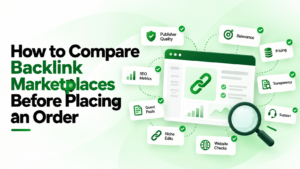
Here are 10 things to check before choosing a backlink marketplace in 2026.
Start by finding out how websites get accepted into the marketplace.
A marketplace that accepts almost every website without meaningful checks can leave you with a large list but very little quality. Look for screening that considers:
Also check whether the marketplace regularly reviews existing publishers. A website that looked healthy six months ago may not have the same quality today.
Domain Authority, Domain Rating, Authority Score, and similar third-party metrics can be useful for comparison, but they should not decide your purchase by themselves. A website with a high metric can still have:
Think of authority metrics as one data point, not the final verdict.
A relevant website with healthy traffic and useful content can be more attractive than a site with a higher score but weak overall quality.
Traffic is one of the most useful signals when evaluating a publisher.
Do not simply look for a traffic number. Ask where that traffic comes from and whether it makes sense for the website. Check:
For example, a technology website claiming millions of monthly visits may look impressive. But if most of its traffic comes from unrelated countries or a handful of questionable pages, the number tells you very little about its actual value.
Relevance should be one of your first checks. A backlink from a website that regularly covers your industry can provide more contextual value than a link from a completely unrelated site with impressive metrics.
Consider three levels of relevance:
For example, a backlink to an SEO tool from a marketing publication makes more contextual sense than the same link placed on an unrelated entertainment website.
Look at the website as a reader, not just as an SEO buyer. Open several recent articles and ask:
Google’s spam policies specifically identify low-value content created mainly to manipulate linking and ranking signals as a problematic practice.
If a website looks like a collection of thin articles created primarily to sell links, treat that as a warning sign.
Do not stop at the question, “Will I get a backlink?” Find out exactly where the link will appear. A strong evaluation should consider:
For example, a contextual link within a genuinely useful paragraph is very different from a link buried in a generic list of sponsors or placed in a site-wide footer.
Before purchasing, understand what type of link the marketplace is offering.
A nofollow link tells search engines that the publisher does not want to pass ranking credit in the usual way. A sponsored attribute is intended for links that are advertisements or paid placements.
Google states that paid links used for advertising and sponsorship can be acceptable when appropriately qualified with rel=”nofollow” or rel=”sponsored”.
The important point is transparency. Know what you are purchasing instead of assuming that every paid placement should pass ranking signals.
The cheapest backlink is rarely the best deal. Instead of comparing only the price, compare what that price includes:
Suppose one publisher charges $80 and another charges $250. If the second website has stronger topical relevance, better content, genuine organic traffic, and a more valuable placement, the higher price may be easier to justify.
Price should be evaluated against quality, not in isolation.
A backlink purchase should not end when the article goes live. Find out what happens if:
A clear replacement or refund policy reduces your risk.
Also check how long the marketplace expects the link to remain live. A placement that disappears after a few weeks is very different from one covered by a clearly defined link-lifetime policy.
Transparency is one of the strongest indicators of a trustworthy backlink marketplace. Before placing an order, you should be able to understand:
If important information is hidden until after payment, consider that a red flag. A good marketplace makes it easier to evaluate a purchase before you commit.
You can use the following scorecard to compare marketplaces and individual publishers consistently:
| Factor | Weight |
| Publisher relevance | 20% |
| Organic traffic quality | 15% |
| Content quality | 15% |
| Link placement | 15% |
| Publisher screening | 10% |
| Backlink profile | 10% |
| Pricing transparency | 5% |
| Replacement/refund policy | 5% |
| Reporting/transparency | 5% |
This is a practical evaluation framework, not an industry-standard formula.
The most important takeaway is that relevance, traffic, content, and placement should carry more weight than a single authority metric.
A backlink marketplace and direct outreach can both help you find publishing opportunities, but they require different levels of effort and control.
| Factor | Marketplace | Direct Outreach |
| Publisher choice | High | High |
| Control | High | High |
| Scalability | High | Low |
| Outreach effort | Low | High |
| Pricing transparency | Usually high | Varies |
| Relationship building | Low | High |
A marketplace is generally more convenient when comparing multiple publishers and scaling your process.
Direct outreach can make more sense when you want to build long-term relationships with specific publishers, journalists, bloggers, or industry websites.
1. Guaranteed ranking promises: No marketplace can honestly guarantee that a specific backlink will produce a particular ranking improvement.
2. Extremely cheap “high-authority” links: Unusually cheap offers can be a reason to investigate the publisher more carefully rather than an automatic bargain.
3. No publisher transparency: Be cautious if you cannot see meaningful information about the website before purchasing.
4. Large numbers of unrelated websites: A marketplace with thousands of publishers is not automatically better. Quality and relevance matter more than inventory size.
5. No replacement or refund policy: If the marketplace provides no clear solution when a link disappears, your purchase carries additional risk.
Choosing the best backlink marketplace in 2026 is less about finding the biggest platform and more about finding the right-quality publishing opportunities.
Start with relevance. Then examine organic traffic, content quality, backlink profile, placement, publisher screening, pricing, and marketplace policies.
Most importantly, do not let a high DA or DR score decide for you. Evaluate the entire website and the specific placement you are considering.
Whether you are evaluating opportunities through Linkpedia or another backlink marketplace, the same principle applies: verify the quality and relevance of the backlink opportunity before spending your money.
A backlink marketplace connects buyers with websites that offer paid placements or sponsored content. It helps streamline publisher discovery, pricing, communication, content, and link placement options.
When evaluating a backlink marketplace, check publisher relevance, organic traffic, content quality, link placement, screening standards, pricing transparency, backlink profiles, and replacement policies carefully before purchasing.
Price varies widely based on publisher quality, relevance, traffic, content requirements, and placement. Compare the complete offer rather than choosing a backlink based on price alone.
Not necessarily. A high domain authority score cannot compensate for irrelevant content, weak organic traffic, poor editorial standards, or a suspicious backlink profile. Evaluate the complete website.
A realistic backlink budget in 2026 is $500–$1,500 monthly for most growing websites, while competitive niches may require $2,000–$5,000+ for quality, relevant placements.