Link Building ROI: How to Measure Whether Your Backlinks Are Actually Working

Link building ROI measures the value a link-building campaign generates compared with its total cost. To determine whether backlinks are working, track link quality, target-page rankings, organic clicks, referral traffic, conversions, and revenue.
Compare these metrics against a baseline, account for other SEO activities, and calculate financial ROI when you can reasonably estimate the value attributable to the campaign.
Link building ROI is the return you receive from the time, money, and resources invested in acquiring backlinks. It helps you determine whether a campaign is contributing enough value to justify its cost.
However, a backlink going live does not automatically mean the campaign is successful. A link might attract relevant visitors, support a page’s search visibility, or contribute to brand discovery. It might also deliver little measurable value.
Consider three levels of performance:
These outcomes are related, but not interchangeable. A campaign can deliver every promised link without producing a measurable increase in revenue.
The goal is to evaluate link building against the results that matter to your business, rather than relying on backlink counts alone.
The most useful link-building metrics cover backlink quality, organic search performance, referral traffic, and business outcomes. Together, they show whether a campaign is delivering its intended results.
1. Backlink Quality and Referring Domains
Track the number of live backlinks, unique referring domains, topical relevance, placement context, and the quality of the linking websites.
Domain Rating (DR) and Domain Authority (DA) can help you compare websites, but these third-party metrics are not direct Google ranking scores or measures of financial return.
A relevant publication with genuine readers may offer more practical value than a website with a higher authority score but little topical connection.
2. Organic Rankings and Search Traffic
Monitor the target pages and keywords associated with your campaign. Look for changes in average positions, impressions, organic clicks, and traffic over time.
Google Search Console’s Performance report lets you examine clicks, impressions, click-through rate, and search queries. Filter the data by page to understand how the URLs targeted by your campaign are performing.
3. Referral Traffic and Engagement
Referral traffic measures visits arriving from other websites rather than search engines. Check the number of sessions, engagement, and conversions generated by individual referring websites.
A backlink that attracts potential customers directly can deliver value even when its contribution to organic rankings is unclear.
4. Leads, Sales, & Revenue
Track the outcomes that support your business goals, such as completed purchases, qualified enquiries, demo requests, and sign-ups.
Use analytics and conversion tracking to understand which traffic sources contribute to these outcomes. Remember that attribution reports show relationships between visits and conversions, not necessarily the incremental effect of a particular backlink.
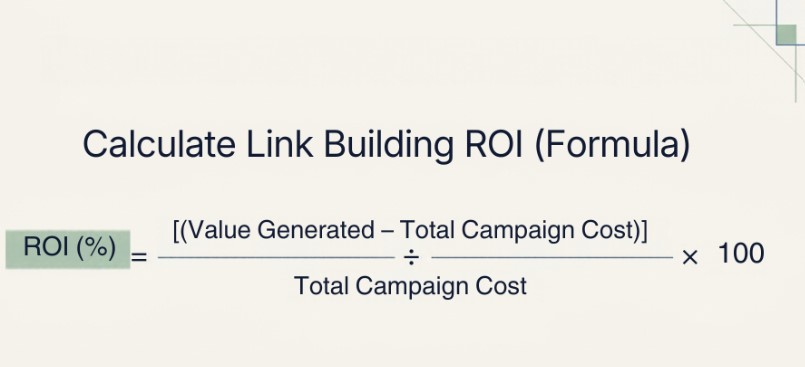
Calculate link-building ROI by subtracting the campaign’s total cost from the value it generates, dividing the difference by the total cost, and multiplying by 100.
Formula:
Link Building ROI (%) = [(Value Generated − Total Campaign Cost) ÷ Total Campaign Cost] × 100
Example: Suppose a campaign costs $2,000 and generates an estimated $5,000 in incremental revenue attributable to the campaign.
ROI = [($5,000 − $2,000) ÷ $2,000] × 100
ROI = 150%
The estimated return above the campaign cost is $3,000, equivalent to a 150% ROI.
The calculation also depends on how accurately you estimate the revenue attributable to link building.
Include all relevant expenses in the campaign cost, such as placement fees, content creation, outreach tools, and staff time. If you only count backlink price, you may overestimate the return.
A consistent tracking process helps you evaluate link-building performance without assuming that every improvement came from a new backlink.
Step 1: Establish a Baseline
Record target-page rankings, organic clicks, impressions, referral traffic, conversions, and existing referring domains before the campaign begins. Note the measurement period so you can make meaningful comparisons later.
Step 2: Maintain a Backlink Tracking Sheet
Record each linking URL, target page, acquisition date, placement cost, anchor text, topical relevance, and link status. This makes it easier to connect campaign activity with subsequent changes.
Step 3: Verify Each Placement
Check that the linking page is accessible, the link points to the intended destination, and the placement matches the agreed requirements. Monitor whether links remain live instead of assuming that a published link will stay available indefinitely.
Step 4: Monitor SEO Performance
Use Search Console to compare organic clicks, impressions, and average positions for targeted pages. Use a backlink analysis tool to review referring domains and link status. Compare equivalent periods and account for seasonality where relevant.
Step 5: Measure Referral Visits and Conversions
Use Google Analytics to identify referral sources, landing pages, and tracked conversions. Google explains how using GSC and Analytics tools together provides complementary views of search performance and website activity.
Step 6: Evaluate the Results Against the Investment
Compare campaign costs with measurable outcomes. Where possible, compare linked pages with similar pages that did not receive new backlinks. This can help you understand whether the linked pages improved differently, although it does not establish causation on its own.
Several measurement mistakes can make an ineffective campaign appear successful or cause a useful campaign to be abandoned too early.
When evaluating opportunities through a backlink marketplace, assess publisher relevance, traffic quality, placement details, and transparent pricing before committing a budget.
Backlinks are working when they contribute meaningful value toward your SEO or business objectives, not simply because your backlink count has increased.
Track placement quality, organic search performance, referral visits, conversions, and total costs together. Compare results against a baseline, account for other changes, and calculate financial ROI only when the available evidence supports a reasonable estimate.
When planning your next campaign, use Linkpedia to explore backlink opportunities and compare potential placements based on relevance, quality, and cost. Combine careful publisher selection with consistent performance tracking to make more informed link-building investment decisions.
Subtract total campaign costs from the estimated incremental value generated, divide the result by total costs, and multiply by 100. Accurate attribution is essential for reliable financial estimates.
Track backlink quality, referring domains, target-page rankings, organic clicks, referral traffic, conversions, and campaign costs. Prioritize metrics that align with your objectives and available data.
The timeline varies by website, competition, and campaign execution. Referral visits may appear quickly, while measurable organic improvements and business outcomes can take longer.
No, Domain Rating is a third-party metric, not a direct measure of financial return. Evaluate relevance, placement quality, traffic, conversions, and campaign costs together.
Use Google Analytics to examine referral traffic and configured conversion events. Compare these results with campaign costs, and distinguish attributed conversions from revenue demonstrably caused by backlinks