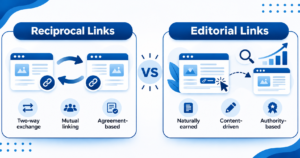
How to Evaluate a Link Exchange Without Looking at DR

To evaluate a link exchange without relying on Domain Rating (DR), check topical relevance, organic visibility, content quality, link placement, backlink patterns, and potential risks. A suitable partner should serve a relevant audience and offer a natural, useful link placement rather than simply having a high DR score.
Domain Rating (DR) measures the relative strength of a website’s backlink profile on a scale of 0 to 100. However, it cannot tell you whether a link exchange is worthwhile.
Consider two websites:
Website B could be the more suitable link exchange partner, even with a lower DR.
DR is an Ahrefs metric, not a Google ranking factor. It can help you compare backlink profiles, but it does not directly measure a link’s relevance or editorial value.
Instead of judging a website by DR alone, evaluate its topical relevance, organic visibility, content quality, proposed link placement, and linking practices.
Evaluate a link exchange by examining six factors: topical relevance, organic visibility, content quality, link placement, backlink and outbound link patterns, and potential red flags. Review each before agreeing to exchange links.
Topical relevance helps you determine whether the other website serves an audience that could benefit from your content. Check the website’s main subject and the specific page proposed for the exchange.
What to look for: The website, article, and destination page should have a clear topical connection. If you cannot explain why the link would help readers, reconsider the exchange.
Organic traffic helps you understand whether a website attracts visitors through search engines. However, traffic estimates alone cannot establish website quality or guarantee that a backlink will improve rankings.
Third-party tools estimate traffic rather than confirm actual visits. If available, first-party analytics can provide stronger evidence about the site’s real performance.
What to look for: Relevant search visibility and credible traffic patterns are encouraging signals, but neither should override serious concerns about the website.
Content quality helps you assess whether a website serves readers or mainly publishes pages to accommodate backlinks. Review several recent articles rather than judging the site by its homepage alone.
What to look for: Choose websites that publish useful, coherent content for a real audience.
The proposed placement matters as much as the website itself. A relevant domain can still offer a poor exchange if the link appears on an unrelated or low-value page.
What to look for: The link should fit the context and provide value to readers, regardless of the website’s DR.
A backlink profile can reveal patterns that deserve further investigation. Examine the relevance of referring websites and how the potential partner links to other domains.
SEO tools can help identify these patterns, but no single report proves that a website manipulates rankings.
What to look for: Assess the overall linking behavior and editorial purpose, not arbitrary backlink counts or one isolated metric.
A link exchange becomes risky when its primary purpose is manipulating search rankings rather than providing value to readers.
Not every reciprocal link violates Google’s policies. The concern is excessive or manipulative linking intended primarily to influence search rankings.
What to look for: Assess the purpose, scale, and context of the exchange. A high DR score cannot compensate for a clearly manipulative arrangement.
Consider a link exchange when the websites have a genuine topical connection, the placement helps readers, and the arrangement does not rely on manipulative linking practices. Investigate or decline opportunities with serious warning signs.
Consider the opportunity when:
Decline or investigate further when:
Do not rely on a numerical score alone. A serious red flag can outweigh otherwise positive signals.
When an exchange does not meet your standards, consider other approaches to strategic link building that focus on relevant content, useful resources, and legitimate editorial relationships.
To evaluate a link exchange without looking at DR, examine topical relevance, organic visibility, content quality, link placement, backlink patterns, and potential manipulation. DR provides context, but it cannot establish whether a specific link belongs on a particular page or whether the exchange is appropriate.
Before agreeing, ask whether the link makes sense for the audience and whether the arrangement follows sound editorial principles. A lower-DR website can be worth considering, while a high-DR website can still be a poor choice.
For anyone comparing link-building opportunities, Linkpedia’s approach should start with relevance, transparency, and placement quality rather than a single domain metric.
DR provides context about a website's backlink profile, but it should not decide whether you accept an exchange. Evaluate relevance, organic visibility, content quality, placement, and potential risks together.
Yes, a low-DR website can be suitable if it serves a relevant audience, publishes useful content, and offers a natural placement. Its linking practices still require evaluation.
Review its topics, organic visibility, recent content, backlink profile, outbound links, and proposed placement. Then assess whether the exchange offers editorial value without manipulative linking practices.
Not all link exchanges violate Google's guidelines. Google identifies excessive reciprocal linking and partner pages created exclusively for cross-linking as link spam when used to manipulate search rankings.
Confirm that the website and article are relevant, the placement helps readers, and the publisher's linking practices appear credible. Decline arrangements that depend on excessive or manipulative exchanges.