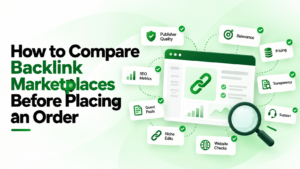
Best Guest Posting Services in 2026: How to Compare Options

The best guest posting service in 2026 is not simply the one with the highest Domain Rating or largest site list. Compare providers by relevance, organic traffic, editorial quality, transparency, placement options, and reporting. LinkPedia, Collaborator, and Adsy are marketplace-based options, while Loganix combines managed placement support with database access and FatJoe focuses on managed blogger outreach.
Guest posting services help businesses publish useful content on third-party websites, often with a relevant link to their own site. Depending on the provider, they may handle publisher discovery, outreach, content creation, placement, and reporting.
A marketplace gives you more control over site selection, while a managed service handles more research and outreach. In either case, quality matters more than simply obtaining a backlink.
A good service should make publisher quality easier to evaluate, not hide it behind impressive metrics.
1. Relevant websites: The publisher should fit your industry, audience, or topic. A relevant site can be more useful than an unrelated site with a higher DR.
2. Real organic traffic: Look beyond DA or DR. Check whether the site attracts genuine search traffic and whether that traffic is relevant to your market.
3. Strong editorial standards: Content should be original, useful, and appropriate for the publication. Be cautious with sites publishing large volumes of unrelated articles.
4. Transparent placements: You should know what is being purchased, which metrics matter, what is included, and how rejected or removed placements are handled.
5. Clear value for money: A higher price can be reasonable when it reflects stronger relevance, traffic, editorial review, content quality, or publisher access.
Use the same criteria for every provider so that the comparison does not become a contest of headline metrics.
| Factor | What to Compare |
| Website relevance | Niche, topic, and audience fit |
| Organic traffic | Genuine and relevant search visibility |
| Authority metrics | DA or DR as supporting signals |
| Editorial quality | Content standards and publishing patterns |
| Placement process | Marketplace selection or managed outreach |
| Transparency | Site details, pricing, and reporting |
| Content | Writing, editing, and revisions |
| Guarantees | Replacement or placement policies |
| Overall value | Quality relative to cost |
The five options below represent different sourcing models. They are compared on relevance, editorial quality, organic traffic, transparency, placement options, and overall value.
Best for: SEO teams, agencies, and businesses that want marketplace control with fulfillment support.
Model: Marketplace
Pros:
Cons: Marketplace users still need to evaluate the individual publisher and placement.
What Stands Out: Linkpedia combines site selection with managed fulfillment. Its platform says publishers are manually reviewed, and placements are monitored with an emphasis on indexing.
Best for: Agencies and SEOs needing a broad marketplace across countries and categories.
Model: Marketplace
Pros:
Cons: Large inventories still require buyers to evaluate individual sites carefully.
What Stands Out: Collaborator’s current catalog lists more than 44,000 websites and provides extensive country and category filtering.
Best for: Buyers wanting large inventory and self-serve filters.
Model: Marketplace
Pros:
Cons: More choice means more responsibility for evaluating publisher quality.
What Stands Out: Adsy currently states that buyers can browse more than 150,000 platforms and filter placements using SEO and traffic metrics.
Best for: Businesses and agencies wanting vetted opportunities with expert selection.
Model: Managed service with a self-serve database option
Pros:
Cons: Managed and higher-tier placements cost more than basic marketplace options.
What Stands Out: Loganix currently lists guest posts from $200 and Authority Links from $400, with stricter traffic and relevance criteria for the latter.
Best for: Agencies and brands wanting hands-off blogger outreach.
Model: Managed service
Pros:
Cons: Less direct control than a marketplace, with pricing increasing for stronger placement metrics.
What Stands Out: FatJoe’s current Blogger Outreach service includes content, genuine outreach, traffic and DR thresholds, and placement-based pricing.
Guest post pricing varies by website quality, traffic, relevance, editorial requirements, and service model. Current provider pricing shows why there is no useful single market-wide rate.
For example, Loganix lists guest post packages from $200, while FatJoe’s current Blogger Outreach pricing starts at $72 for lower DR placements and rises to $456 for DR60+ placements. These are provider-specific prices, not universal benchmarks.
Before comparing prices, check what the fee includes:
A cheaper placement is not automatically better value if the website has weak relevance or little genuine traffic.
| If you need… | Consider… |
| Marketplace control with fulfillment | Linkpedia |
| Broad international marketplace | Collaborator |
| Large inventory and self-serve filters | Adsy |
| Vetted placements with expert selection | Loganix |
| Hands-off outreach at scale | FatJoe |
Choose a marketplace if you want more control over publisher selection. Choose a managed service if saving outreach and prospecting time matters more.
The best guest posting service in 2026 is the one that fits your goals without making quality difficult to verify. Compare relevance, organic traffic, editorial standards, transparency, placement process, and total value before choosing a provider.
Guest posting works best when useful contributions take priority over publishing large volumes of low-quality articles.
Guest posting can support SEO when content is useful, relevant, and editorially appropriate. Its value comes from quality placements, not publishing large volumes of low-quality articles.
Guest posting prices vary by website quality, traffic, relevance, content, and service model. Current providers range from lower-cost placements to several hundred dollars per link.
Compare publisher relevance, organic traffic, editorial quality, transparency, pricing, content standards, placement guarantees, and reporting. Do not choose based on DA or DR alone.
They can be, but quality and intent matter. Avoid manipulative link schemes, irrelevant sites, excessive keyword-rich anchors, and large-scale publishing designed primarily to influence rankings.
Check the site’s relevance, organic traffic, content quality, publishing patterns, backlink profile, placement context, pricing, and whether delivery and replacement terms are clearly explained.
Guest posting is one link-building method, not a replacement for digital PR, original research, partnerships, or organic link earning. A strong strategy can combine several relevant approaches.