Why More Businesses Are Switching to Link Building Marketplaces in 2026

Businesses are switching to link building marketplaces because they can simplify publisher discovery, reduce outreach time, provide more predictable pricing, and make backlink campaigns easier to manage at scale.
Link building has always required time, research, and judgment. The challenge in 2026 is not simply finding websites that can provide a backlink. It is finding relevant, trustworthy opportunities efficiently while keeping campaigns organized.
That is where link building marketplaces are becoming increasingly useful.
Traditional link building often involves finding relevant websites, identifying contacts, sending outreach emails, negotiating placements, and following up.
This can work well for relationship-driven campaigns, but it becomes difficult to manage at scale.
Businesses are increasingly looking for ways to reduce repetitive work without removing human evaluation from the process. A marketplace can help by bringing publisher discovery, pricing, ordering, and campaign management into one workflow.
The goal is not simply to build more links. It is to find better opportunities more efficiently.
A link building marketplace is a platform that connects businesses or agencies with publishers offering link placement opportunities.
Users can typically browse websites and compare factors such as niche, traffic, authority metrics, location, pricing, and placement type.
The basic process is:
This can reduce the manual prospecting involved in traditional outreach while giving businesses a centralized way to manage campaigns.
Finding suitable publishers can take more time than expected.
A marketplace gives businesses access to a searchable pool of websites, making it easier to discover opportunities by niche, location, traffic, or other criteria.
For example, a SaaS company looking for technology, marketing, and business publishers can filter relevant opportunities in one place instead of building separate prospect lists for each campaign.
The advantage is speed, but every publisher should still be evaluated before a placement is selected.
Traditional outreach requires prospecting, finding contact information, writing emails, sending follow-ups, and managing responses.
That workload grows quickly when an SEO team is running several campaigns.
Marketplaces can centralize much of the process, reducing repetitive communication and administrative work.
Direct outreach remains useful for building long-term publisher relationships, but marketplaces can be more efficient when businesses need repeatable access to multiple opportunities.
Negotiating every placement individually can make backlink budgets difficult to predict.
Many marketplaces show pricing upfront, allowing businesses to compare opportunities before committing to them.
This makes it easier to plan a campaign around a fixed budget and understand how different publishers compare in terms of cost.
Price should not be the deciding factor, though. A cheaper placement from an irrelevant or low-quality website may provide less value than a more expensive, highly relevant opportunity.
Marketplaces can put important publisher information in one place.
Businesses may be able to compare:
This makes publisher selection and link prospecting more systematic. However, metrics are only screening signals. A website with strong numbers is not automatically a good link opportunity if its content is unrelated or its audience does not match your business.
Link prospecting should consider both website quality and relevance.
Manual outreach can be manageable for a small campaign but becomes resource-intensive when link building needs to continue every month.
Marketplaces can make the process easier to repeat across multiple clients, products, industries, or markets.
This is especially useful for agencies and in-house teams that need a steady flow of potential publishers.
The goal should be to scale the quality of opportunities, not simply the number of backlinks.
Managing placements through emails and spreadsheets can become confusing as campaigns grow.
A marketplace can bring publisher selection, orders, communication, content requirements, and placement tracking into one workflow.
Teams can more easily see which placements are pending, completed, or live and monitor campaign spending.
For recurring campaigns, this organization can save considerable administrative time.
Guest posting is only one approach to acquiring links.
Depending on the marketplace, businesses may find guest posts, niche edits, sponsored content, and other placement formats.
Having multiple options allows marketers to choose placements that better fit their campaign.
The format still matters less than the context. A relevant mention that benefits readers is generally more meaningful than content created solely to insert a backlink.
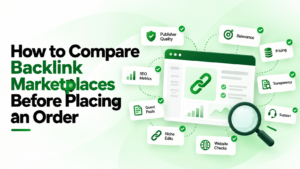
The best link building marketplace should combine relevant publishers, transparent pricing, reliable metrics, clear placement policies, and efficient campaign management.
1. Publisher quality and relevance: Look for websites with genuine topical relevance, useful content, and signs of a real audience. In our experience, publisher relevance is often a better first filter than authority score alone.
2. Transparent pricing: Understand exactly what you are paying for and whether additional content or placement costs apply.
3. Reliable metrics: Review traffic, referring domains, authority metrics, indexing, and other available signals. Do not rely on one metric.
4. Clear placement policies: Understand where the link will appear, how the content will be published, and whether the placement is editorial or sponsored.
5. Campaign management: Useful filters, communication, reporting, order tracking, and live-link monitoring can make a marketplace more practical for ongoing campaigns.
There is also an important SEO consideration. Google recommends qualifying paid or sponsored links with rel=”sponsored” or rel=”nofollow”.
Link building marketplaces are generally faster and easier to scale, while traditional outreach offers more control and stronger opportunities for direct publisher relationships.
| Factor | Link Building Marketplace | Traditional Outreach |
| Publisher discovery | Faster | Manual |
| Outreach | Centralized | Done individually |
| Pricing | Usually visible upfront | Often negotiated |
| Scalability | Easier | More resource-intensive |
| Control | Depends on marketplace | More direct |
Neither approach is automatically better.
Marketplaces are useful when efficiency and scalability matter, while traditional outreach offers more direct control and relationship-building opportunities.
Many businesses can use both, depending on the type and value of the link opportunity.
The future of link building marketplaces is likely to focus less on publisher volume and more on relevance, quality, transparency, and smarter campaign workflows.
Businesses are becoming more selective about where they build links. Topical relevance, genuine traffic, content quality, and audience fit matter more than simply finding a website with a high authority score.
A marketplace with fewer but better-vetted publishers can therefore be more useful than one offering thousands of questionable opportunities.
Authority metrics will continue to help with initial screening, but they are only part of the picture.
Future marketplace workflows are likely to make it easier to evaluate publishers using a wider set of signals:
This can help businesses make decisions based on the overall quality of an opportunity rather than one SEO metric.
Automation will also play a bigger role in publisher discovery, filtering, ordering, reporting, and link monitoring.
The benefit is not removing people from the process. It is reducing repetitive tasks, so SEO teams can spend more time on strategy and quality control.
The future of link building marketplaces can be summed up simply: Less time finding links. More time evaluating the right ones.
As marketplaces evolve, the platforms that make quality, relevance, and transparency easier to assess are likely to become more valuable to businesses and SEO teams.
More businesses are switching to link building marketplaces because they make publisher discovery, pricing, outreach, and campaign management more efficient.
But a marketplace does not automatically make a backlink valuable.
Businesses should still evaluate relevance, publisher quality, traffic, placement context, and SEO guidelines before selecting an opportunity. Used carefully, a marketplace such as Linkpedia can become a practical part of a scalable link building strategy.
Link building marketplaces can be used responsibly, but businesses should evaluate publisher quality, relevance, placement practices, and Google’s guidelines before purchasing any link opportunity.
A link building marketplace makes sense when you need scalable publisher discovery, predictable workflows, easier comparison, and less manual outreach across ongoing SEO campaigns.
A marketplace connects businesses with publishers offering link placements. Users browse opportunities, compare publishers and pricing, select placements, provide requirements, and track delivery.
Choose a marketplace with relevant publishers, transparent pricing, reliable metrics, clear placement policies, useful filters, and strong campaign management features.
Not always. Marketplaces offer efficiency and scalability, while traditional outreach provides more direct relationships and control. The better option depends on your campaign goals.